+1
Other
Blood Flow Restriction Training Simplified
Order multiple courses
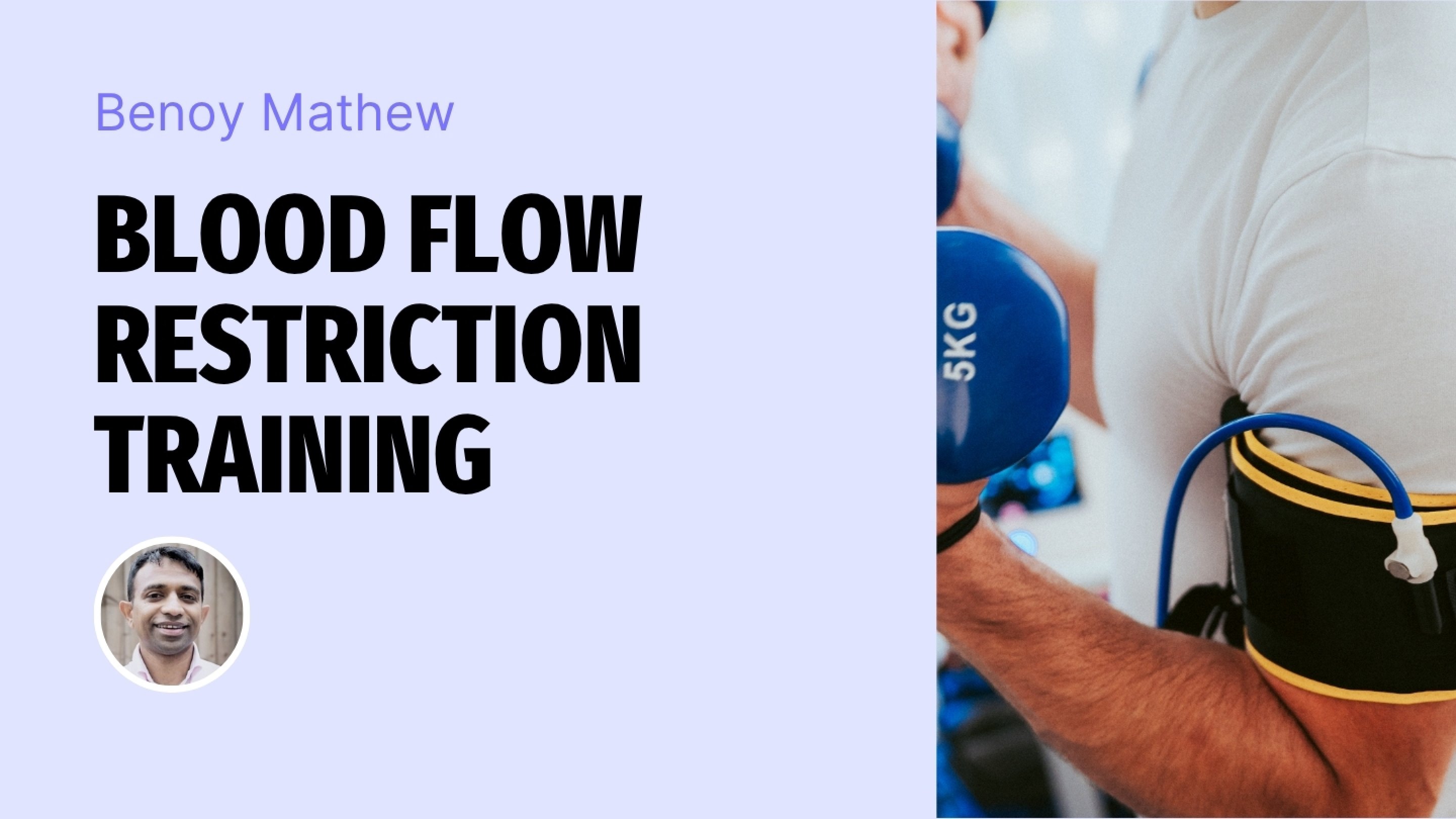
Blood Flow Restriction Training in MSK Rehabilitation: Evidence, Safety and Clinical Application
Blood Flow Restriction (BFR) training allows clinicians to create a meaningful strength and hypertrophy stimulus while using relatively low external loads. This makes it particularly useful when pain, surgery, tissue healing, or load intolerance limits conventional heavy resistance training. This course equips physiotherapists and healthcare professionals with the knowledge and practical skills to apply BFR safely and effectively across a range of musculoskeletal conditions.
Course Overview
This course covers the physiological mechanisms of BFR, patient screening, safety, Limb Occlusion Pressure (LOP), exercise prescription, and clinical progression. You will learn how BFR can be integrated into rehabilitation for post-operative knee patients, patellofemoral pain, knee osteoarthritis, tendinopathy, and upper-limb conditions including shoulder and elbow pathology.
The course also teaches you to critically evaluate the evidence and recognize where BFR is most useful as a temporary bridge when conventional loading is not yet tolerated, rather than as a replacement for progressive resistance training.
What You Will Learn
Physiology and Clinical Rationale: Understand how metabolic stress, hypoxia, motor-unit recruitment, cellular swelling, and anabolic signalling allow low-load exercise to produce a greater training stimulus.
Safe Screening and Application: Learn how to screen patients, identify contraindications and precautions, obtain informed consent, and apply BFR safely using individualized LOP.
BFR Prescription and Progression: Learn how to select cuff pressure, load, repetitions, rest periods, exercise type, and progression based on the patient and rehabilitation stage.
Condition-Specific Rehabilitation: Apply BFR in knee surgery rehabilitation, knee pain, osteoarthritis, tendinopathy, shoulder and upper-limb rehabilitation, and lateral elbow tendinopathy.
Evidence-Based Clinical Reasoning: Understand where the evidence is strong, where it remains emerging, and how to decide when BFR adds value within a broader rehabilitation programme.
Interactive Learning and Practical Application
Video Demonstrations and Quizzes: Learn practical BFR setup, pressure determination, exercise selection, safety procedures, and progression through video instruction and interactive quizzes.
Clinical Examples and Decision Making: Work through real-world rehabilitation scenarios that challenge you to determine when BFR is appropriate, how to prescribe it, and when to progress toward conventional loading.
Why This Course Stands Out
Clinically Focused: The course goes beyond standard BFR protocols and teaches you how to make patient-specific decisions based on pathology, rehabilitation stage, load tolerance, and clinical goals.
Strong Focus on Safety: Screening, individualized pressure prescription, supervision, and ongoing monitoring are integrated throughout the course rather than treated as an afterthought.
Evidence-Based and Critical: The course distinguishes established clinical evidence from emerging and mechanistic findings, helping you avoid overgeneralizing BFR research across different populations and body regions.
Broad Clinical Application: Learn how BFR can be adapted across post-operative rehabilitation, painful musculoskeletal conditions, tendon rehabilitation, and both lower- and upper-limb presentations.
Outcome
By the end of this course, you will have the knowledge and practical framework to determine when BFR is appropriate, screen patients safely, prescribe and progress individualized BFR programmes, and integrate the technique confidently into musculoskeletal rehabilitation
Related courses


Benoy Mathew
Advanced Practice Physiotherapist
Benoy is a highly specialist physiotherapist and works as an advanced practice Physiotherapist for the National Health Service (NHS), London, and also in private practice in Central London, mainly treating runners and complex lower limb injuries. He qualified as a physiotherapist in 1998 and completed his Masters in London in 2014. Clinically, he specializes in the management of difficult musculoskeletal and sports injuries with a particular focus on overuse running injuries and young hip and knee injuries. He is passionate about the application of research in clinical practice and is involved in regular teaching on multiple courses, both in the UK and overseas. More than 2500 participants from 12 countries have attended his course in the last 8 years. He is a Master Trainer in Shockwave therapy and is the UK head of education for Venn Health Care. He is also a trained MSK Sonographer and uses diagnostic ultrasound regularly, in his clinical practice.
0
Curriculum
Accreditation
Accreditation for this course will be requested in the Netherlands (KNGF/KRF) and Belgium (ProQ-Kiné). The number of points will be listed here once approved.
All participants receive a CPD certificate of completion stating the course duration (30 hours).
No questions have been asked yet. Be the first to start the conversation and ask your question about this course.